
In an important judgment delivered on 08 May 2026 in Special Civil Application No. 5112 of 2026, the Gujarat High Court dismissed a petition filed by a serving Additional District Judge challenging the departmental inquiry initiated against him. The Court also directed that the matter relating to certain allegations made by the petitioner against a senior High Court Judge be placed before the appropriate Bench dealing with contempt matters for consideration of criminal contempt proceedings.
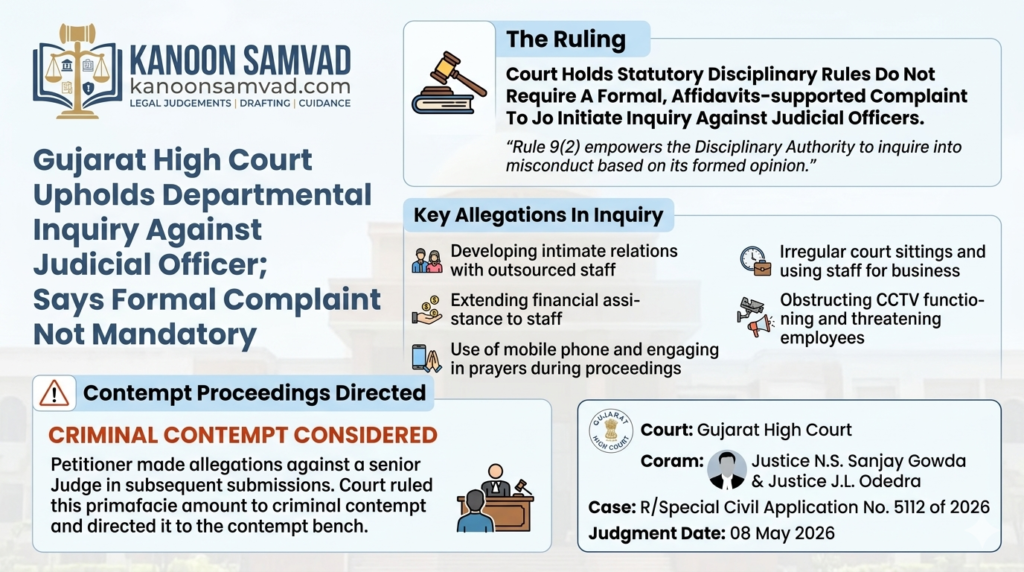
The Division Bench comprising Justice N.S. Sanjay Gowda and Justice J.L. Odedra examined whether disciplinary proceedings against a judicial officer could be initiated without a written complaint supported by affidavit and verifiable material.
Background of the Case
The petitioner, a serving Additional District Judge, had been placed under suspension on 16 December 2024 in contemplation of disciplinary proceedings. Subsequently, on 25 January 2025, a charge-sheet containing six charges was issued against him.
The allegations included:
- Developing intimate relations with an outsourced clerk;
- Extending financial assistance to her;
- Using court staff for assisting in her business activities;
- Obstructing CCTV functioning;
- Irregular court sittings;
- Use of mobile phone and engaging in prayers while presiding over court proceedings;
- Allegedly threatening court employees and witnesses.
The petitioner challenged the suspension and inquiry proceedings before the Supreme Court on two occasions but later withdrew those petitions with liberty to approach the High Court.
Thereafter, the petitioner filed the present writ petition before the Gujarat High Court seeking:
- Quashing of the departmental inquiry;
- Quashing of suspension order;
- Transfer of inquiry to another Judge;
- Dropping of disciplinary proceedings.
Main Legal Issue Before the Court
The principal argument advanced by the petitioner was that no departmental inquiry against a judicial officer could be initiated unless there was:
- A written complaint,
- Supported by a sworn affidavit, and
- Accompanied by verifiable material.
The petitioner relied upon guidelines issued by the Ministry of Law and Justice pursuant to directions of the Chief Justice of India concerning complaints against subordinate judiciary.
Findings of the High Court
Rejecting the petitioner’s contentions, the Court held that the statutory disciplinary rules governing judicial officers do not require the existence of a formal complaint before initiation of inquiry.
The Court extensively referred to Rule 9(2) of the Gujarat Civil Services (Discipline and Appeal) Rules, 1971, which empowers the Disciplinary Authority to initiate inquiry whenever it forms an opinion that there are grounds to inquire into misconduct or misbehaviour.
The Court observed that:
“The statutory rule does not contemplate the requirement of there being any complaint, oral or written, for initiation of inquiry.”
According to the Court, the only requirement under the rules is formation of opinion by the Disciplinary Authority regarding existence of sufficient grounds for inquiry.
The judgment further clarified that the guidelines requiring complaints to be accompanied by affidavits were primarily intended to deal with frivolous complaints filed by disgruntled litigants against judicial officers and could not curtail the independent disciplinary powers of the High Court under Article 235 of the Constitution.
The Court emphasized that the High Court, being the highest judicial authority in the State, may receive information regarding misconduct from various sources and can act upon such information if it considers disciplinary inquiry necessary.
On Challenge to Charge-sheet During Ongoing Inquiry
The Court also refused to interfere with the charge-sheet at the stage of ongoing departmental proceedings. It held that issues such as vagueness of charges can be raised before the Inquiry Officer and disciplinary authority during the inquiry process itself.
The Bench reiterated the settled principle that constitutional courts ordinarily do not interfere with charge-sheets or pending disciplinary inquiries unless exceptional circumstances exist.
Contempt Proceedings Directed
An important aspect of the judgment relates to written submissions personally filed by the petitioner after arguments had concluded and judgment had been reserved.
In those written submissions, the petitioner made allegations suggesting that a senior High Court Judge exercised influence and control over junior judges of the High Court.
The Bench took serious exception to these statements and observed that such assertions by a serving judicial officer tended to scandalize the judiciary and lower the authority of the Court.
The Court held that the allegations prima facie amounted to criminal contempt under the Contempt of Courts Act as they interfered with the administration of justice and undermined public confidence in judicial independence.
Accordingly, the Bench directed that the papers relating to those allegations be placed before the Division Bench assigned with contempt jurisdiction for consideration of further proceedings.
Final Order
The Gujarat High Court ultimately dismissed the writ petition and permitted continuation of the departmental inquiry against the judicial officer.
The Court also directed the petitioner to remain personally present before the appropriate contempt Bench on the next date fixed in the matter.
📌 Case: R/Special Civil Application No. 5112 of 2026
📌 Court: Gujarat High Court
📌 Judgment Date: 08 May 2026
📌 Coram: Justice N.S. Sanjay Gowda & Justice J.L. Odedra
